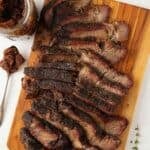
Southern Smoked Chuck Roast with Bourbon Bacon Onion Jam
If you've always wanted brisket-style barbecue without the brisket price tag, this smoked chuck roast is for you. Slow-smoked until tender and topped with bourbon bacon onion jam, it's a backyard barbecue favorite that is surprisingly easy to make.
Servings: 8 servings
Calories: 334kcal
Equipment
- Smoker, fuel, and wood for smoking See notes below
- Uncoated butcher paper
- A leave-in meat and grate thermometer
Ingredients
BOURBON COFFEE DRY RUB
- 2 tablespoons kosher salt or 1 tablespoon table salt
- 2 tablespoons coarse ground black pepper
- 1 tablespoon garlic powder
- 1 tablespoon onion powder
- 1 tablespoon smoked paprika
- 1 tablespoon finely ground dark roast coffee
- 1 teaspoon brown sugar
- ½ teaspoon cayenne pepper
BOURBON COFFEE SPRITZ
- ½ cup strong brewed coffee cooled
- ¼ cup bourbon
- 2 tablespoons Worcestershire sauce
- ¼ cup apple cider vinegar
SMOKED CHUCK ROAST
- 1 boneless chuck roast 3 to 4 pounds, recommend 3 inches thick
- 2 tablespoons yellow mustard binder
- 2 tablespoons salted butter for wrapping
BOURBON BACON ONION JAM
- 1 pound thick-cut bacon cut into ½-inch pieces (plain, maple or applewood)
- 2 large yellow onions finely chopped (about 3 cups)
- ¼ cup packed brown sugar
- 4 tablespoons bourbon divided
- 2 tablespoons balsamic vinegar
- 2 teaspoons apple cider vinegar
- 1 tablespoon strong brewed coffee
- 3 to 4 sprigs fresh thyme
- ½ teaspoon kosher salt or heaping ¼ teaspoon table salt, or to taste
- ½ teaspoon freshly cracked black pepper or to taste
- ¼ cup water plus more as needed
Instructions
DRY BRINE (OPTIONAL BUT RECOMMENDED)
- Mix together all of the dry rub ingredients in a small bowl and stir until well combined. Coat the chuck roast all over with the yellow mustard, using your hands or a pastry brush to spread it into a thin, even layer. This acts as a binder and disappears completely during the cook; you will not taste it.
- Sprinkle the dry rub generously over all sides of the roast, pressing it in lightly so it adheres. You want an even coating, but not so thick that you cannot see any of the meat underneath. Too heavy a coat will block the smoke from penetrating and can prevent bark from forming properly.
- Place the seasoned roast on a wire rack set over a rimmed baking sheet and refrigerate, uncovered, for 8 hours or overnight (max 24 hours). If you are short on time, let it sit at room temperature for at least 30 minutes before smoking.
MAKE THE BOURBON BACON ONION JAM
- This jam can be made a day ahead and reheated, which frees up your time on smoke day. Add the bacon pieces to a large, heavy-bottomed skillet or Dutch oven over medium-low heat. Cook, stirring occasionally, until the fat has fully rendered and the bacon is deeply crisp, about 30 to 35 minutes. You want the pieces genuinely crispy here, because they will soften slightly once they go back into the jam. Transfer the bacon to a paper towel-lined plate and pour off all but 2 to 3 tablespoons of the bacon fat from the pan.
- Add the chopped onions to the pan with the reserved bacon fat and cook over medium-low heat, stirring every 5 to 10 minutes, for about 8-10 minutes until they begin to soften. Add the brown sugar and stir to combine. Continue cooking, stirring occasionally, for another 50 to 60 minutes until the onions are deeply golden, jammy, and reduced. Do not rush this step by turning up the heat; low and slow is what turns onions into something magical.
- Add the crispy bacon back to the pan along with 3 tablespoons of the bourbon, the balsamic vinegar, apple cider vinegar, coffee, and thyme sprigs. Stir everything together and cook for another 10 to 15 minutes, stirring occasionally, until the liquid has mostly cooked down. Add the water and the remaining 1 tablespoon of bourbon, stir to combine, and cook for 5 more minutes. Remove and discard the thyme sprigs. Season with salt and freshly cracked pepper to taste. The jam should be thick and spoonable. If it tightens up too much as it sits, stir in another tablespoon or two of water. Makes approximately 1 ½ cups.
SMOKE THE CHUCK ROAST
- Combine all of the spritz ingredients in a clean spray bottle, shake gently to mix, and set aside.
- Get your pellet smoker started with the lid open. Then close the lid and heat to 225°F for 15 minutes. Oak, hickory, or pecan wood pellets all work well here. Cherry adds a sweeter smoke if you prefer a milder flavor.
- Place the chuck roast directly on the grill grate. Insert a leave-in wireless thermometer probe into the thickest part of the roast, making sure it is not touching fat or resting against the grate. Close the lid.
- After the first hour, begin spritzing the roast lightly with the bourbon coffee spritz about every 45 minutes. Do not overdo it. A light mist is all you need. The goal is to keep the surface from drying out too fast while still allowing the bark to build. Don’t leave the lid open any longer than necessary.
- Smoke the roast at 225°F until the internal temperature reaches 160°F to 165°F, which will take approximately 3 to 4 hours depending on the size and shape of your roast. At this point you will see a dark, mahogany crust forming on the outside. This is the bark, and it is exactly what you are after.
WRAP AND FINISH
- The temperature stall on chuck roast often hits right in the 150°F to 160°F window and it can feel like nothing is happening for a long stretch. If you have time, wait it out. The stall will break on its own, usually within 1 to 2 hours, and the bark will be even better for it. If the roast is at least 155°F, you can wrap it early to save time. The butcher paper will trap heat and help push through the stall faster without steaming the bark.
- Lay out a large piece of uncoated butcher paper on a clean work surface. If you are using 24" wide paper, pull a generous length of about 24 to 30 inches and one layer is sufficient as long as your wrap is snug. If you are using 18" wide paper, pull about 36 inches and use two overlapping sheets or fold and wrap in two layers to make sure you have enough paper to seal the roast completely without fighting the edges.
- Remove the roast from the smoker and place it towards one end of the butcher paper. Increase the smoker temperature to 250°F while you wrap the roast. Slice the 2 tablespoons of salted butter and add it on top of the roast. To wrap, fold the nearest narrow end over the roast. Then fold both sides over the tip, overlapping in the center. Roll the roast once and tug on it to tighten the folds. Leaving the width of the roast plus an inch or two of remaining paper, trim off the excess. Fold the end over about an inch or two to help contain juices. Roll the roast one more time.
- Place the wrapped roast back on the smoker seam side down so the weight of the roast holds everything closed. Continue cooking until the internal temperature reaches 200°F to 203°F and the roast feels probe tender when you test it.
- If the roast reaches 200°F but isn’t probe tender, continue checking on it every 15-20 minutes. If the roast never feels probe tender, remove from the smoker at 215°F anyway.
REST
- Remove the roast from the smoker and do not unwrap it. Set it on a baking sheet or cutting board and let it rest, still wrapped, for a full 60 minutes before slicing. This step is not optional. During the rest, the internal temperature will continue to rise slightly and then slowly drop as the juices redistribute back into the meat. Cutting into it too early will cause those juices to run out onto your board instead of staying in every bite.
SERVE
- Carefully unwrap the roast, preserving the meat juice for serving. Slice against the grain into ½-inch thick slices, or pull it apart with two forks if you prefer a shredded style. Arrange on a serving platter and spoon a touch of reserved meat juice over the slices. Top generously with warm bourbon bacon onion jam. Serve extra jam alongside for the table.
Notes
How to Make Smoked Chuck Roast on a Gas or Charcoal Grill or a Big Green Egg
The directions shown above are for a pellet smoker. This recipe was tested using both a pellet smoker and a Big Green Egg. However, with a few simple adjustments, you can get genuine smoke flavor and a great bark on a gas or charcoal grill. The result will not be quite as deeply smoky as a dedicated pellet smoker or Big Green Egg, but it is surprisingly close. We’ve also found that it’s very difficult to maintain a stable temperature on standard grills over long cooking times.
Gas Grill
You will need a smoker box or a small disposable aluminum pan filled with soaked wood chips for this method. Soak 2 cups of wood chips in water for at least 30 minutes before you start, then drain them well. Fill your smoker box or foil pan with the soaked chips and place it directly over one of the burners on the far side of the grill. Turn that burner to high until the chips begin to smoke, then reduce it to medium-low. Turn all remaining burners off. Place the seasoned chuck roast on the grate on the opposite side of the grill from the smoker box. This is indirect-heat cooking, meaning the roast should never be placed directly over a lit burner. Close the lid and adjust the lit burner to maintain a grill temperature between 225°F and 250°F. Add a fresh batch of soaked wood chips every 45 minutes to 1 hour to keep the smoke going. Follow the same internal temperature targets, spritzing schedule, and butcher-paper wrapping instructions as in the main recipe. Total cook time will be similar to the pellet smoker method, approximately 6 to 8 hours.
Charcoal Grill
Set up your charcoal grill for a two-zone fire. Light a full chimney of charcoal and once the coals are ashed over, pour them onto one side of the grill only, leaving the other side empty. Place the seasoned chuck roast on the grate on the empty side. Add 3 to 4 chunks of your chosen smoking wood directly onto the hot coals. Do not use wood chips here. Chunks burn more slowly and are better suited to a long cook. Close the lid with the top vent positioned over the roast and the bottom vent open about halfway. Adjust both vents to maintain a temperature as close as possible to 225°F to 250°F. Check the coals every 60 to 90 minutes and add 8 to 10 fresh briquettes as needed to maintain the heat. Add another wood chunk each time you add fresh coals. Follow the same internal temperature targets, spritzing schedule, and butcher-paper wrapping instructions as in the main recipe.
Big Green Egg
New to smoking on a Big Green Egg? This quick one-minute video walks you through the setup I use for recipes like this smoked chuck roast, including how to arrange the charcoal and wood chunks, install the ConvEGGtor, and stabilize the temperature at 225°F. Big Green Egg for Smoking
Fill the fire box with lump charcoal. Add 3–4 chunks of pecan, oak, or hickory wood, tucked into the charcoal. Light in one or two spots only. Install the ConvEGGtor/plate setter for indirect cooking, legs up. Add a drip pan on top of the ConvEGGtor and pour one cup of water into it. Put the cooking grate in place. Bring the Egg slowly to 225°F, with the bottom vent barely open and the top vent cracked. Let it stabilize for 15–20 minutes before adding meat. Follow the same internal temperature targets, spritzing schedule, and butcher-paper wrapping instructions as in the main recipe.
Tips for all Methods
A reliable oven or grill thermometer clipped to the grate near the roast is essential for gas and charcoal cooking because the built-in lid thermometers on most grills read the temperature at the top of the dome, not at grate level where the meat actually sits. The grate temperature can be 25°F to 50°F lower than what the lid gauge shows, which matters on a long cook like this one.
Wind, outdoor temperature, and how often you lift the lid all affect how well you can hold a steady temperature. Every time the lid comes off, you lose heat and smoke. Trust your thermometer probe and resist the urge to check the roast visually until it is time to spritz.
For this cook, I monitored both the grate temperature and the meat using a ThermoWorks Signals meat and grate thermometer paired with a Billows temperature-control fan. The Billows helps to maintain a steady cooking temperature without constant vent adjustments.
Recipe notes:
To quickly prep bacon for the jam, slice the entire package of bacon (after removing it from the plastic) into ½-inch strips. After cooking, break up any extra-large pieces with your fingers. Typically, the slices render into about ½-inch square crisps of bacon.
Smoked chuck roast benefits from overnight dry brining because the salt has time to draw a small amount of moisture to the surface, dissolve, and then absorb back into the meat, seasoning it all the way through rather than just on the outside. Even a 30-minute rest after seasoning helps, but 8 to 24 hours makes a noticeable difference in the finished flavor.
The stall is normal and expected. Around 150°F to 160°F, the internal temperature of your smoked chuck roast will stop rising and may even drop slightly. This happens because moisture evaporating from the surface of the meat cools it at the same rate the smoker heats it, much like sweating cools the human body. The stall can last anywhere from 30 minutes to 2 hours. Do not panic and do not turn up the heat. Wrapping in butcher paper at this stage helps push through the stall faster while still protecting the bark.
Probe tenderness matters more than temperature. Target 200°F to 203°F, but use probe feel, not just the number, to decide when your smoked chuck roast is done. Ideally, it should feel like you’re pressing the probe into warm butter with little resistance. Some roasts are ready at 198°F, while others need to reach 205°F. Trust the probe. (Be careful with using the probe to check for tenderness, I have stuck mine all the way through the butcher paper and lost all of my cooking liquid before.)
The bourbon in the jam is added in two stages on purpose. The first tablespoon cooks down and concentrates the flavor, while the second tablespoon, added at the very end, stays bright and keeps the whiskey flavor from disappearing entirely into the sweetness of the onions.
Coffee in both the rub and the spritz deepens the roast's savory, beefy character without making it taste like a cup of coffee. It enhances the Maillard reaction, the browning process that creates bark, and adds an earthy bitterness that balances the sweetness of the rub and the jam.
Substitutions
- Yellow mustard (binder) - olive oil, mayonnaise, or Dijon mustard work equally well as a binder
- Bourbon (spritz and jam) - apple juice makes a good alcohol-free swap in both; the flavor will be sweeter and lighter
- Thick-cut bacon - regular-cut bacon can be used, but will crisp up faster; watch it closely so it does not burn during rendering
- Brown sugar (rub) - coconut sugar or omit entirely for a less sweet bark
- Smoked paprika - regular sweet paprika works; add an extra pinch of cayenne to compensate for the lost depth
- Fresh thyme (jam) - ¼ teaspoon dried thyme can be substituted; add it with the onions rather than at the end
Nutrition
Calories: 334kcal | Carbohydrates: 0.2g | Protein: 33g | Fat: 22g | Saturated Fat: 10g | Polyunsaturated Fat: 2g | Monounsaturated Fat: 11g | Trans Fat: 1g | Cholesterol: 125mg | Sodium: 202mg | Potassium: 571mg | Fiber: 0.2g | Sugar: 0.1g | Vitamin A: 112IU | Vitamin C: 0.01mg | Calcium: 32mg | Iron: 4mg
